
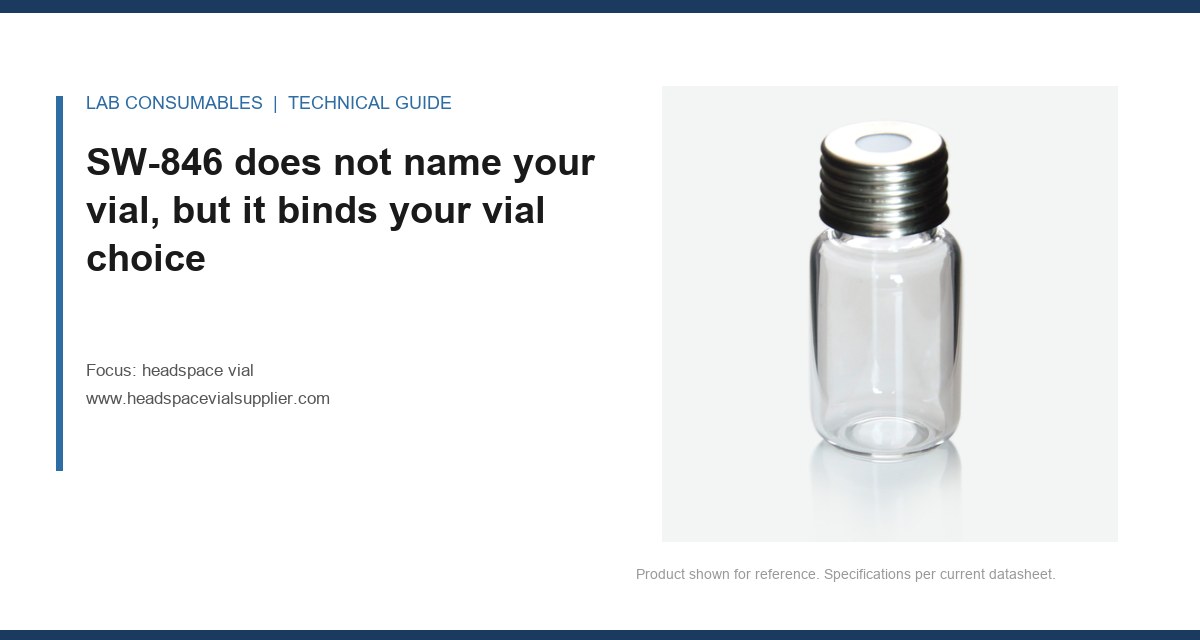
A lab manager called me last Tuesday about a volatile organic analysis run that got kicked back by a state auditor. The audit finding was not about calibration drift or surrogate recovery. It was about the headspace vial lot. The auditor asked for the certificate of analysis, the lot-specific dimensional check, and the closure torque validation record. None of it existed. The run had used 2,400 vials from a new supplier, and the data package was rejected over a $0.18 component. That is what EPA method expectations for headspace vial and auditor expectations look like in practice: the vial is a data integrity issue, not a consumable afterthought.
SW-846 is the umbrella document for EPA methods that cover volatile organic compounds, semivolatiles, and hazardous waste characterization. Methods like 8260D, 8260E, 5021A, and 5035A all reference sample containers, preservation, holding times, and quality control. What they do not do is specify a manufacturer part number for a headspace vial. That gap is exactly where auditors focus, because the method language creates obligations that the vial must satisfy without saying which vial satisfies them.
Method 5021A, for example, requires that the sample vial be septum-sealed, that the headspace volume be known, and that the vial be heated to a specified temperature for a specified time. It also requires that the analyst demonstrate that the vial does not contribute target analytes or interfere with quantification. Read that again: the method places the burden of proof on the laboratory. The vial is not a passive container. It is an active contributor to the analytical result, and the auditor will ask you to prove you controlled it.
What an auditor asks for before they look at your chromatograms
Auditors do not start with peak shapes. They start with the paper trail that connects the vial lot to the data package. The first three documents an auditor requests are almost always the same.
First, the certificate of analysis for the specific lot of vials used in the reported run. This C of A must show the vial was manufactured from Type I borosilicate glass conforming to USP <660> or ASTM E438 for hydrolytic resistance. It must also show the septum material, typically PTFE/silicone, with a stated durometer and thickness. If the C of A is generic, not lot-specific, the auditor will mark it deficient.
Second, the closure torque or crimp validation record. For crimp-top vials, the crimp force must be within the range specified by the vial and septa manufacturer, usually 0.6 to 0.8 N·m for 20 mm closures, depending on the cap material. For screw-thread vials, the torque is typically 8 to 12 in-lbs. An auditor will ask how you verified that every cap in the run was seated to that range, or at least that the instrument or tool was calibrated and a representative sample checked.
Third, the blank verification record showing that a vial from the same lot, filled with reagent water or matrix blank and run through the full headspace cycle, produced no target analyte peaks above the method detection limit. This is not a nice-to-have. Method 5021A and 8260D both require demonstration of non-interference from the sample container. If you cannot produce that record for the lot in question, the data package is vulnerable.
The dimensional spec auditors actually check, and the one they should
Most laboratories think the headspace vial is defined by its nominal capacity: 10 mL, 20 mL, or 22 mL. An auditor will check that the vial volume matches the method requirement. For EPA methods, the most common headspace vial is 20 mL, with a 22.5 mm × 75.5 mm body and a 20 mm crimp neck. But the nominal volume is the least interesting number on the drawing.
The dimension that causes silent method failures is the neck inner diameter and the sealing surface flatness. A vial with a neck ID that is 0.1 mm too wide, or a sealing lip with a 0.05 mm dip, will not compress the septum evenly. That produces a slow leak. The leak may not cause a visible pressure drop in a single run, but it reduces headspace pressure reproducibility across a batch. The RSD on replicate injections climbs from under 3% to 8% or more, and the method’s precision requirement, typically ≤20% RSD for volatile organics in 8260D, is technically met, but the auditor will still ask why the precision degraded from historical performance.
The practical check is a four-place balance weight loss test on a sealed vial filled with methanol or water, held at the method temperature, usually 80°C or 90°C, for 60 minutes. A properly sealed 20 mL vial should lose less than 0.5 mg over that period. If you see 2 mg or more, the sealing surface or the septum is out of spec. That is a measurement an auditor can replicate, and one you should run on every new lot before it enters service.
Septum selection under EPA methods is a chemical compatibility decision, not a price decision
The septum is the single largest source of headspace vial failure in EPA work. The default material is PTFE/silicone, with the PTFE layer facing the sample and the silicone layer providing resealability and compression. The PTFE layer is typically 0.5 to 1.0 mm thick. Thinner PTFE layers cost less but allow more permeation of volatile analytes into the silicone, which then releases them back into later blanks or samples. That is carryover, and it is a direct method violation.
For methods that involve chlorinated solvents or aggressive matrices, a PTFE/butyl septum is the safer choice. Butyl has lower gas permeability than silicone, which reduces analyte loss during the heating step. The tradeoff is resealability: butyl does not reseal as well after multiple punctures. If your autosampler makes multiple injections from the same vial, or if you store the vial after an initial analysis, butyl may not be the right call.
The puncture count matters more than most labs admit. A 20 mm PTFE/silicone septum rated for 3 to 4 punctures at a 23-gauge needle will start to leak after the third puncture if the needle is not perfectly centered. Off-center punctures tear the PTFE layer and compress the silicone unevenly. An auditor will not ask about puncture count directly, but they will ask why your duplicate injections from the same vial show increasing variability. The answer is often septum fatigue.
Method 5035A and the low-level trap: why the vial becomes a sample preparation device
Method 5035A is the EPA method for low-level volatile organic compounds in soils and solid waste. It uses a closed-system purge-and-trap with a vial that serves as both the sample container and the extraction vessel. The vial is filled with a preservative, typically sodium bisulfate or methanol, depending on the analyte list and concentration range. The vial is then sealed, shipped, and heated in the autosampler.
This method puts two demands on the headspace vial that generic 20 mL vials do not always meet. First, the vial must withstand the chemical environment of the preservative without leaching or etching. Sodium bisulfate is acidic, with a pH below 2 in solution. Low-quality borosilicate glass, or glass with a high alkali content, will release sodium and calcium ions into the sample matrix. That changes the ionic strength and can shift partitioning of polar volatiles. The C of A should state hydrolytic class Type I, which corresponds to a titration of less than 0.1 mL of 0.02 N sulfuric acid per gram of glass in the USP <660> test.
Second, the vial must seal tightly enough to prevent loss of the preservative or ingress of air during shipping and storage. Method 5035A samples often sit in a cooler for up to 14 days before analysis. A vial that leaks 0.2 mL of headspace gas per day will show a measurable loss of target volatiles, especially the lighter compounds like vinyl chloride and dichlorodifluoromethane. The auditor will check the cooler temperature log and the vial integrity record, and they will compare the surrogate recovery from field samples against the laboratory control sample. A low field surrogate recovery with a normal LCS is a classic sign of vial leakage in transit.
The audit trail for vial certification is shorter than you think
An EPA auditor does not need to see your entire quality system. They need to see the chain from the vial lot to the reported result. That chain has five links, and each one must be documented.
- Lot receipt record: date, supplier, lot number, quantity received, and the C of A that accompanied the shipment.
- Dimensional verification: measured neck ID, body OD, height, and sealing surface flatness for a representative sample, typically 5 vials per case of 100.
- Closure torque or crimp validation: the target torque or crimp force, the instrument used, and the calibration date of that instrument.
- Blank verification: a chromatogram from a vial of the same lot, run under method conditions, showing no target analytes above the MDL.
- Usage log: which sample IDs were run with which vial lot, so that a data package can be traced back to the specific consumable.
Most laboratories have the first and the last. The middle three are where audits fail. I have seen a full data package rejected because the dimensional verification was performed on a different lot than the one used in the run. The lab had the right procedure, but the lot number on the form did not match the lot number on the sample log. That is a paperwork error, but the auditor treats it as a data integrity issue, because it is one.
What the autosampler does to the vial that the method assumes you controlled
EPA methods assume the headspace vial is heated evenly and that the headspace pressure is stable during sampling. Your autosampler does not guarantee that. It applies a needle force, a heating profile, and a pressurization cycle that stress the vial and septum in specific ways.
The needle force for a typical autosampler is 2 to 5 N, depending on the instrument. A 20 mm crimp septum is designed to withstand that force without tearing, but only if the needle is sharp and centered. A dull or barbed needle tears the PTFE layer on the first puncture. After three punctures with a dull needle, the septum may not reseal at all, and the vial will not hold pressure during the sampling step.
The heating profile matters for glass integrity. A 20 mL borosilicate vial rated for 120°C will survive a method that heats to 80°C, but only if the heating is uniform. Autosamplers with a heated carousel that heats vials from the bottom only can create a temperature gradient of 10 to 15°C between the bottom and the top of the vial. That gradient changes the headspace partitioning of analytes with high Henry’s law constants, and it also stresses the glass unevenly. A vial that is repeatedly cycled through 80°C with a 15°C gradient will eventually develop microcracks at the shoulder, where the glass is thinnest.
The practical check is to run a temperature mapping study on your autosampler with a vial filled with mineral oil and a fine thermocouple. If the gradient exceeds 5°C, you need to adjust the carousel loading pattern or switch to a vial with a thicker wall, typically 1.2 mm instead of the standard 1.0 mm.
Field case: the 5021A run that failed on septum permeation, not injection
A contract lab running Method 5021A for soil gas samples saw a persistent carryover problem: benzene appeared in the method blank after every high-concentration sample. The lab blamed the autosampler needle, replaced it twice, and still saw the carryover. The actual cause was the septum. They had switched to a cheaper PTFE/silicone septum with a 0.3 mm PTFE layer, down from the 0.8 mm layer they had used before. The thin PTFE allowed benzene to permeate into the silicone during the 30-minute heating step at 80°C. When the next vial was run, the silicone released the benzene back into the headspace. The fix was to return to the 0.8 mm PTFE layer septum and to add a post-run bakeout step for the vial tray. The carryover disappeared, and the blank stayed below the MDL. The auditor had flagged the carryover in the initial data package, and the lab had to re-run 47 samples.
Field case: the 8260D precision failure traced to a crimp force drift
A wastewater lab running Method 8260D for volatile organics saw their replicate RSD climb from 2.8% to 9.4% over a two-week period. The calibration was fine, the internal standard areas were stable, and the autosampler passed its leak check. The problem was the crimper. The lab used a manual crimper with a spring mechanism that had fatigued over time. The crimp force had drifted from 0.7 N·m to 0.4 N·m, which was not enough to fully compress the septum against the vial lip. The vials sealed well enough to pass a quick visual check, but they leaked slowly during the 15-minute equilibration at 40°C. The RSD on the internal standard areas was still under 10%, so the method precision requirement was technically met, but the auditor asked why the RSD had tripled from historical performance. The fix was to replace the crimper and to add a weekly crimp force verification using a torque gauge. The RSD returned to under 3% within two runs.
Decision checklist for an EPA headspace vial lot
| Check | Pass criteria | Action if fail |
|---|---|---|
| Glass type | Type I borosilicate, USP <660> hydrolytic class Type I | Reject lot, do not use for EPA work |
| Neck ID | 20 mm crimp neck, ID within ±0.05 mm of drawing | Reject lot or quarantine for non-EPA use |
| Sealing surface flatness | No visible dip or scratch under 10× magnification | Reject individual vials, verify rest of lot |
| Septum PTFE thickness | ≥0.5 mm for routine work, ≥0.8 mm for low-level or carryover-sensitive methods | Use only for high-concentration screening |
| Crimp force | 0.6 to 0.8 N·m for 20 mm aluminum crimp caps | Adjust crimper, re-verify on 5 vials per case |
| Weight loss at method temperature | <0.5 mg over 60 minutes at 80°C | Reject lot or investigate septum and sealing surface |
| Blank verification | No target analyte above MDL in reagent water blank | Reject lot, do not use for EPA reporting |
Where the vial fits into the full EPA data package
The headspace vial is not an isolated component. It sits inside a chain that includes the autosampler, the GC inlet, the column, and the detector. An auditor will trace that chain from the sample log to the final report, and the vial is the first physical object in that chain. If the vial lot is not documented, the rest of the chain does not matter.
For laboratories that run EPA methods on a regular basis, the practical move is to standardize on a single headspace vial configuration and to qualify each new lot before it enters service. That means a dimensional check, a blank verification, and a torque or crimp validation, all documented against the lot number. It also means keeping the C of A on file for at least as long as the data package retention period, which under EPA rules is typically 5 years for hazardous waste characterization.
The same discipline applies to the other consumables in the chain. A GC vial used for the calibration standards must meet the same lot documentation standard, because an auditor will ask whether the calibration standards were stored in a container that could have contributed contamination. The reagent bottle used for the preservative or the extraction solvent is part of the same audit trail, because a bottle with a poor closure can allow the preservative to degrade before it reaches the sample. And the HPLC autosampler vial used for any confirmatory analysis must meet the same documentation standard, because the auditor does not distinguish between GC and LC consumables when they are checking the sample handling chain.
The external references matter here too. The EPA SW-846 methods are the controlling documents, and they are available in full. The Agilent chromatography consumables documentation includes application notes on headspace vial selection that align with the method requirements. Thermo Fisher sample handling resources cover the closure and septum compatibility questions in detail. And Restek technical resources include chromatograms showing the carryover and blank contamination effects of poor septum selection, which are useful when you need to explain to a lab manager why the cheaper septum is not actually cheaper.
The decision rule is simple: if the vial lot cannot be traced to a C of A, a dimensional check, a blank verification, and a closure force validation, it does not belong in an EPA data package. The vial costs less than a dollar. The re-run costs a day of instrument time, a full set of standards, and the credibility of the laboratory with the auditor. That trade is never worth it.
References & further reading
Related resources from our lab consumables network:
- Headspace Vial at headspacevialsupplier.com
- Gc Vial at gcvialfactory.com
- Reagent Bottle at reagentbottleforsale.com
- Hplc Autosampler Vial at hplcautosamplervials.com
External references and standards: