
Three vials from the same lot, filled with identical standard, gave RSDs of 2.1%, 4.8%, and 9.3% in a residual solvent method. The method had passed validation two months earlier. The analyst blamed the autosampler. I pulled the vial certificates and found the lot had changed suppliers mid-year without a USP requirement review. The USP requirements for headspace vial in a validated method are not a single chapter you read once. They are a set of boundary conditions that decide whether your consumable is still the same consumable your validation assumed. When a lot changes, the method does not care what your purchase order said. It cares about dimensions, thermal mass, and the surface the sample actually sees.
USP chapter <661.1> reaches the headspace vial through the closure system, not the glass alone
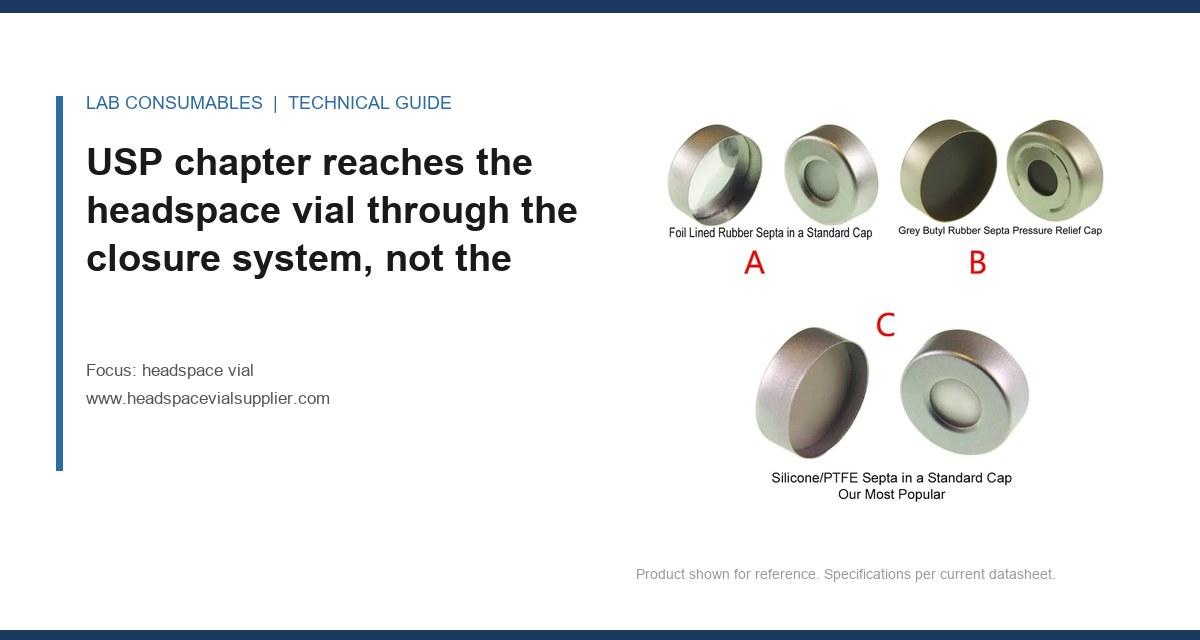
Most analysts assume USP <661> is a plastic packaging chapter. It is, but the scope has expanded in ways that directly affect headspace work. USP General Chapter <661.1> covers plastic materials of construction, including the septa and the polymeric coatings on closures. A headspace vial is a two-part system: a glass body and a closure that includes an aluminum cap and a septum. The septum is the part USP <661.1> actually regulates. The glass body falls under <660>, Containers—Glass, which sets chemical resistance and hydrolytic resistance classes.
What this means in practice: when you qualify a headspace vial for a validated method, you are qualifying two materials under two different USP chapters. The glass must meet Type I borosilicate requirements under <660>. The septum must meet the extractables and identity tests under <661.1>. A supplier that lists only “USP Type I glass” on the certificate is telling you half the story. The septum is where most headspace method drift originates.
<661.1> does not prescribe a septum formulation, so the lab owns the compatibility decision
This is the part most people get wrong. USP <661.1> tells you how to test a plastic material for extractables, heavy metals, and biological reactivity. It does not tell you which septum material is appropriate for your solvent, your temperature, or your analyte polarity. That decision is yours. A PTFE-lined silicone septum and a butyl septum can both pass <661.1> and behave completely differently in a headspace method at 90°C with a polar solvent.
I have seen a validated method for ethanol in plasma fail a system suitability test after a septum change. The original septum was PTFE/silicone. The replacement was butyl rubber. The butyl septum absorbed ethanol during equilibration and released it unevenly across replicate injections. The RSD went from 1.8% to 6.4%. Both septa had USP <661.1> compliance statements. The lab had not written a septum material specification into the method. That is the gap USP leaves open, and it is the gap your validation needs to close.
What <661.1> actually measures
- Extractable metals: the septum is extracted under specified conditions and the extract is analyzed for a defined metal panel.
- Non-volatile residue: a measure of material that migrates out of the septum under stress.
- Heavy metals: a limit test, not a quantitative assay, for lead and related elements.
- Biological reactivity: relevant only for parenteral or implant applications, rarely for headspace GC work.
None of these tests tell you whether a septum will bleed volatile siloxanes into your headspace at 120°C. None of them tell you whether the septum will core after 40 punctures. Those are performance properties, not compendial properties. You measure them yourself, and you write the results into your method specification.
USP <660> sets the glass class, but not the dimensional tolerance your autosampler needs
USP <660> classifies glass containers as Type I, II, III, or NP based on hydrolytic resistance. Headspace vials are Type I borosilicate, which means they resist leaching of sodium and other alkali metals into aqueous samples. That matters for a water-based sample held at 80°C for 30 minutes. A Type III soda-lime vial would release enough sodium to shift pH and change the partitioning of ionizable analytes.
What <660> does not specify is the outer diameter, the neck geometry, the crimp profile, or the flange thickness. Those are the dimensions that determine whether your vial seats correctly in the autosampler tray, whether the crimp seals evenly, and whether the needle punctures the septum at the same point every time. A vial can be fully USP <660> compliant and still fail in a validated method because the neck ID is 0.2 mm wider than the vial your validation used.
I keep a set of go/no-go gauges on my bench for this reason. The critical dimensions for a standard 20 mL headspace vial are:
- Body OD: 22.5 mm ± 0.2 mm
- Height: 75.5 mm ± 0.5 mm
- Neck ID: 12.5 mm ± 0.1 mm
- Flange OD: 20.0 mm ± 0.2 mm
If a new lot falls outside these numbers, the method is no longer validated. The USP chapter will not catch it. Your incoming inspection has to.
The septum reseal requirement is a method parameter, not a compendial one
USP <381> covers elastomeric closures for injections. It includes a self-sealing test that measures whether a closure reseals after needle puncture. A headspace vial septum is not an injection closure, but the same physical principle applies. The septum must reseal after the autosampler needle withdraws, or the vial pressure drops between injections and the headspace concentration changes.
I have measured this directly. A 20 mL headspace vial pressurized to 2.0 bar with helium should hold that pressure for at least 24 hours after a single puncture. A septum that leaks 0.1 bar in 30 minutes will produce a measurable drop in peak area on the second and third injections from the same vial. The leak rate is not in any USP chapter. It is a property you specify based on your method’s sensitivity to pressure loss.
For a method that takes three injections from one vial, I require a septum that survives 3 punctures with less than 5% pressure loss. For a method that takes one injection and discards the vial, the requirement relaxes to 1 puncture with less than 2% loss. The septum material, thickness, and durometer all feed into this number. A 1.0 mm thick PTFE/silicone septum has a different puncture recovery profile than a 1.3 mm butyl septum. You cannot read this off a USP certificate.
What a validated method must specify beyond the USP chapters
Here is the decision checklist I use when reviewing a headspace vial specification for a validated method. If any of these are missing, the method is exposed to supplier and lot drift.
| Parameter | What USP covers | What the lab must specify | Typical value for 20 mL headspace |
|---|---|---|---|
| Glass class | <660> Type I | Confirm Type I on every lot certificate | Type I borosilicate |
| Septum formulation | <661.1> material compliance | Exact material and thickness | PTFE/silicone, 1.0 mm or 1.3 mm |
| Septum reseal | Not covered | Pressure retention after puncture | <5% loss after 3 punctures |
| Septum bleed profile | Not covered | Volatile extractables at method temperature | <0.1% of analyte peak area at 120°C |
| Crimp integrity | Not covered | Torque or crimp force range | 18–22 in-lb for 20 mm crimp |
| Vial dimensions | Not covered | OD, height, neck ID, flange OD | 22.5 mm, 75.5 mm, 12.5 mm, 20.0 mm |
| Puncture count | Not covered | Maximum injections per vial | 1–3 depending on method |
The crimp torque is a number most labs never write down. They crimp by feel. That is a mistake. An under-crimped cap leaks during equilibration. An over-crimped cap deforms the septum and creates a channel for vapor loss. I use a calibrated torque wrench set to 20 in-lb for 20 mm aluminum caps. Anything below 18 in-lb risks a leak. Anything above 22 in-lb risks septum extrusion. Write the number down, train analysts to hit it, and audit it quarterly.
Field case: a lot change that passed USP but failed the method
A contract lab running a USP <467> residual solvents method on a headspace GC saw a sudden increase in baseline noise. The noise appeared as a series of small peaks between 2 and 4 minutes, right where acetone and isopropanol elute. The analyst ran blanks, baked the column, and replaced the liner. Nothing changed.
I pulled the septum from a new vial and ran a direct thermal desorption of the septum alone at 120°C for 30 minutes. The chromatogram showed the same pattern. The new lot of septa was a different silicone formulation from a different supplier. The USP <661.1> certificate was clean, but the septum was bleeding low molecular weight siloxanes that the previous lot did not. The fix was to write a septum bleed specification into the method: extract a septum at the method equilibration temperature and require that no peak exceed 10% of the height of the smallest calibration standard peak. The new lot failed that test. The lab switched back to the original supplier.
Field case: a dimensional drift that produced inconsistent peak areas
A pharmaceutical QC lab noticed that peak areas for a volatile impurity in a drug product were drifting downward over a three-week period. The method was a validated headspace method with a 10-minute equilibration at 85°C. The RSD across six replicates had been 1.5% at validation. It was now 5.2%.
I measured the vial height of the current lot against the validation lot. The new lot was 0.4 mm shorter. That does not sound like much, but the autosampler needle penetration depth is fixed. A shorter vial means the needle tip sits 0.4 mm higher in the headspace. For a vial with 5 mL of sample in a 20 mL volume, that shift changes the effective sampling position and the amount of headspace vapor drawn. The fix was to reject the lot based on the dimensional specification and to add a vial height check to incoming QC. The method returned to 1.6% RSD.
USP <467> imposes method requirements that flow down to the vial
USP <467> is the residual solvents chapter. It is a method chapter, not a container chapter, but it imposes conditions that the headspace vial must survive. The method specifies equilibration temperatures up to 105°C for Class 2 solvents. The vial must hold pressure at that temperature without leaking. The septum must not absorb the target solvents during equilibration. The glass must not catalyze degradation of thermally labile analytes.
I have seen a vial fail a <467> system suitability test because the septum absorbed dimethyl sulfoxide during equilibration. DMSO is a Class 3 solvent with a high boiling point. It partitions into silicone septa at 105°C. The result is a loss of DMSO from the headspace and a low recovery. The fix is to use a septum with a thicker PTFE barrier layer or to switch to a butyl septum for that specific method. USP <467> does not tell you this. The method development data does.
For methods that reference U.S. EPA SW-846 test methods for waste and materials, the same logic applies. The vial is a sample contact surface. The method’s temperature, pressure, and solvent conditions define the vial’s duty cycle. The USP chapters define the material’s baseline acceptability. Neither is sufficient alone.
How to write the headspace vial specification section of a validated method
Most method SOPs have a “Materials” section that says “20 mL headspace vial, crimp cap, PTFE/silicone septum.” That is not a specification. It is a shopping list. A specification that protects a validated method includes the following:
- Glass class: Type I borosilicate per USP <660>, confirmed by lot certificate.
- Vial dimensions: body OD, height, neck ID, flange OD with tolerances.
- Septum material: exact formulation and thickness, not a generic “PTFE/silicone” label.
- Septum bleed limit: measured at the method equilibration temperature, expressed as a percentage of the lowest calibration standard.
- Reseal requirement: pressure retention after the maximum number of punctures the method uses.
- Crimp torque: a number, not a feel.
- Supplier and part number: the exact SKU used in validation, with a change control trigger if the supplier changes.
If you do not write these numbers down, the next lot change will rewrite the method for you. That is not a USP problem. It is a specification problem.
Where the USP chapters stop and the supplier’s data takes over
Suppliers like Agilent chromatography consumables and columns and Thermo Fisher chromatography and sample handling publish dimensional drawings and material datasheets for their headspace vials. Those datasheets are the bridge between USP compliance and method performance. They give you the actual OD tolerance, the septum thickness, the recommended crimp torque, and sometimes the maximum temperature rating.
What they do not give you is the bleed profile at your specific temperature with your specific solvent. That is your measurement. A GC vial supplier can tell you the septum is 1.0 mm PTFE over silicone. They cannot tell you whether that septum will bleed at 120°C in your method because your method’s sensitivity is different from the next lab’s. The same logic applies to reagent bottle materials and HPLC autosampler vial components. The compendial chapter sets the floor. Your method sets the ceiling.
A troubleshooting checklist for headspace vial failures in a USP-validated method
When a validated headspace method drifts, the vial is the first suspect and the last one checked. Here is the order I follow:
- Check the septum bleed: run a blank vial with a fresh septum at the method temperature. Compare the chromatogram to the validation blank. Any new peak is a septum problem.
- Check the vial dimensions: measure height, OD, and neck ID on 5 vials from the current lot. Compare to the validation lot. A 0.2 mm shift is enough to matter.
- Check the crimp torque: use a torque wrench on 10 vials. If the range exceeds 18–22 in-lb, retrain the analysts or replace the crimper.
- Check the septum reseal: pressurize a crimped vial to 2.0 bar, puncture once, and measure pressure after 30 minutes. A drop over 5% means the septum is not resealing.
- Check the lot certificate: confirm the glass is Type I and the septum material matches the method specification. A supplier can change the septum formulation without changing the part number.
These are not USP tests. They are your tests. USP <660> and <661.1> tell you the materials are acceptable for their intended use. They do not tell you the materials are acceptable for your method. That distinction is the entire point of validation.
The decision rule is simple. If the vial lot you are using today would fail the specification you wrote at validation, the method is no longer validated. Not because USP says so. Because the data you generated at validation was generated with a different consumable. The USP requirements for headspace vial in a validated method are the starting point. The method-specific specification you write and enforce is the ending point. Restek technical resources for chromatography has useful reference data on septum bleed and dimensional tolerances, but the final numbers belong in your SOP, not in a supplier’s catalog.
References & further reading
Related resources from our lab consumables network:
- Headspace Vial at headspacevialsupplier.com
- Gc Vial at gcvialfactory.com
- Reagent Bottle at reagentbottleforsale.com
- Hplc Autosampler Vial at hplcautosamplervials.com
External references and standards: