
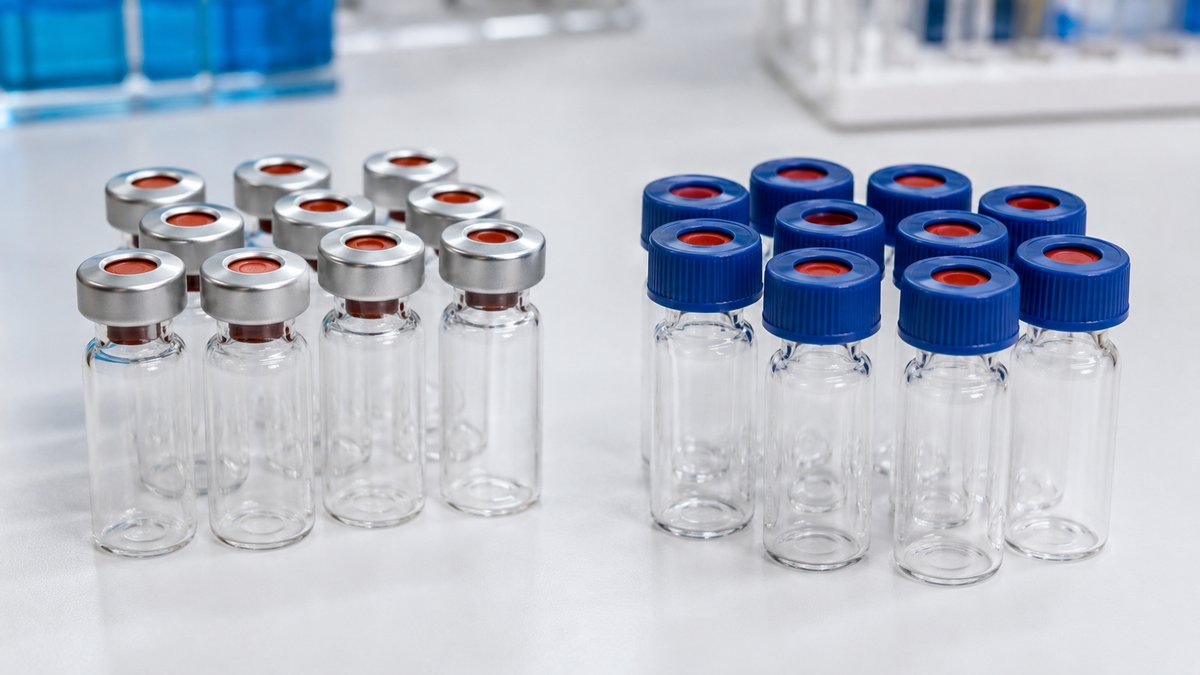
1. Structural Design and Sealing Mechanism Differences
The core distinction between crimp caps and screw caps lies in the mechanical method used to apply sealing force to the septa:
- Crimp Cap: Typically manufactured from aluminum or zinc-plated steel/magnetic aluminum. During sealing, a dedicated crimper applies radial and axial plastic deformation to the aluminum skirt, forcing it tightly against the vial lip beneath the neck. This mechanical fastening is irreversible and provides a uniform, constant 360° interference fit.
- Screw Cap: Usually composed of polypropylene (PP) or metal threads (common specifications include 9-425, 10-425, and 20-400). The sealing force originates from axial torque generated by thread rotation. Because sealing relies on thread engagement, the force is concentrated along the thread lead direction, and the sealing load is significantly influenced by manual tightening torque.
2. Sealing Performance and VOC Loss Prevention
For VOC analysis, preventing trace-level analyte diffusion and evaporation is the primary performance criterion for a closure system.
| Evaluation Aspect | Crimp Cap | Screw Cap |
|---|---|---|
| Sealing Force Stability | Metal skirt exhibits no elastic creep; compression force remains constant during long-term storage | PP material is prone to stress relaxation over time and with temperature fluctuations |
| Torque Consistency | Dependent on constant-pressure crimpers; inter-vial sealing consistency is extremely high (CV < 1%) | Influenced by operator technique; torque variation typically ranges from 0.5–1.5 N·m |
| Sealing Failure Mode | Fails only upon vial breakage or insufficient crimping | Over-tightening causes “septa buckling” or deformation, creating micro-channels |
| VOC Control Performance | Excellent (loss rate < 0.2%/24h for highly volatile halocarbons and BTEX compounds) | Good (with precise torque control), but higher risk of micro-leakage during prolonged high-temperature equilibration |
Under typical gas expansion and high-temperature equilibration conditions, crimp caps maintain a fixed compression ratio (septa compression typically maintained within the optimal 20%–25% range), effectively suppressing permeation loss of highly volatile components such as methyl chloride and dichloromethane.
3. Septa Compatibility and Needle Puncture Recovery
VOC analysis commonly employs PTFE/silicone double-layer or triple-layer septa. The PTFE layer provides chemical inertness, while the silicone layer supplies compressive resilience.
- Force Distribution and Flatness:
The flat metal top ring of a crimp cap distributes force evenly across the septa’s outer edge, keeping the PTFE contact surface flat. During screw cap tightening, if friction between the septa and the cap’s inner wall is high, rotational twisting can occur, causing scratches or cracking in the PTFE layer and introducing trace impurity background. - Puncture and Self-Sealing Capability:
After autosampler needle penetration, hole closure relies on lateral constraint stress applied to the silicone. Crimp caps tightly envelop the septa’s sides, providing strong lateral force that enables rapid hole closure and rebound after needle withdrawal—suitable for long sequences requiring multiple injections. Screw caps offer weaker lateral constraint depending on the cap’s inner wall clearance, resulting in slightly inferior self-sealing performance.
4. Headspace and GC-VOC Application Scenarios
Headspace analysis (HS-GC) involves prolonged vial heating (80°C–180°C) and internal pressure buildup (typically 2–4 bar / 30–60 psi):
- Thermal Expansion Coefficient Matching: The difference in thermal expansion coefficients between borosilicate glass and aluminum is significantly smaller than that between glass and PP. At high headspace temperatures of 150°C, PP screw caps soften and expand, reducing thread engagement and leading to headspace gas leakage, which degrades quantitative peak area reproducibility (RSD > 5%).
- Overpressure Safety Protection: Professional 20mm headspace crimp aluminum caps are designed with safety bridges (pressure-relief scores). When abnormal reactions cause internal pressure to exceed approximately 6 bar, the aluminum cap opens in a controlled manner along these scores, preventing vial rupture and laboratory safety hazards.
- Trace Contamination (Ghost Peaks): Plastic materials or mold-release agents in screw caps may release volatile organic oligomers at elevated temperatures. In contrast, aluminum caps undergo high-temperature degreasing and cleaning, providing a cleaner system blank suitable for ppb-level VOC standard methods such as EPA 524 and 8260.
5. Operational Efficiency, Automation, and Total Cost
Beyond analytical performance, laboratory operational efficiency and procurement costs are critical evaluation factors.
- Equipment Dependency: Crimp caps require manual, pneumatic, or electric crimpers/decappers (initial equipment investment approximately 500–2,500). Screw caps require no additional tools and can be tightened by hand.
- Automation Compatibility: In robotic workstations requiring automated reagent addition, online derivatization, or automated cap removal (e.g., CTC PAL systems), screw caps with automated gripper modules offer unparalleled flexibility advantages.
- Consumable Unit Cost: 11mm/20mm aluminum crimp caps typically cost 25%–40% less than precision screw caps of equivalent specifications. In high-throughput laboratories consuming hundreds of vials daily, this cost difference becomes substantial.
6. Decision Guidance and Application Scenario Comparison
To assist laboratories in making precise selections during method development and consumable procurement, the following decision matrix is provided:
| Evaluation Criterion / Application Scenario | Recommended Cap Type | Key Parameters / Suggested Operating Values | Decision Basis |
|---|---|---|---|
| EPA 524/8260 VOC Drinking Water/Soil Analysis | Crimp Cap | 11mm or 20mm aluminum cap + PTFE/Silicone septa (thickness 1.5–3.0mm) | Eliminates trace VOC evaporation, ensures RSD < 2% and high system cleanliness |
| High-Temperature Headspace Analysis (HS-GC, T > 120°C) | Crimp Cap | 20mm safety-bridge aluminum cap; crimp depth adjusted to achieve ~20% septa compression | Prevents thread loosening and leakage at high temperatures; ensures controlled overpressure release |
| High-Throughput Automated Cap Removal/Reagent Addition Workstations | Screw Cap | Magnetic precision screw cap; tightening torque set to 0.8–1.0 N·m | Compatible with robotic gripper cap removal; avoids crimper mechanical failures interrupting workflows |
| Routine GC-FID Analysis (High-Concentration VOC) | Screw Cap | 9-425 threaded vial + pre-assembled screw cap with septa | Tool-free operation, improved sample preparation efficiency, reduced labor intensity |
| Long-Distance Transport or Long-Term Sample Archiving | Crimp Cap | After crimping, verify the aluminum cap is immovable and the vial neck is firmly sealed | Completely eliminates micro-leakage risk from thread loosening due to transport vibration |
Summary
Related Resources from hplcvials.com:
- Product: 11mm crimp cap septa hplc gc nd11 vial seals
- Guide: Crimp Vial vs. Snap Vial vs. Screw Cap Vial, How t…
- Guide: Your Headspace Vial Cap is Crimping Tight Enough?
- Guide: Solutions for Volatile Organic Compounds (VOCs) Sa…
For demanding trace VOC analysis, high-pressure headspace analysis, and long-term sample retention, crimp caps remain the industry-standard choice due to their unmatched mechanical compression consistency and high-temperature sealing stability. For laboratories prioritizing operational convenience, frequent cap removal, or reliance on specific high-automation systems, high-precision screw caps can adequately meet routine mid-to-high-concentration analysis requirements. Laboratories should comprehensively evaluate target analyte volatility, analytical sensitivity, and automation equipment configuration to make an informed selection.